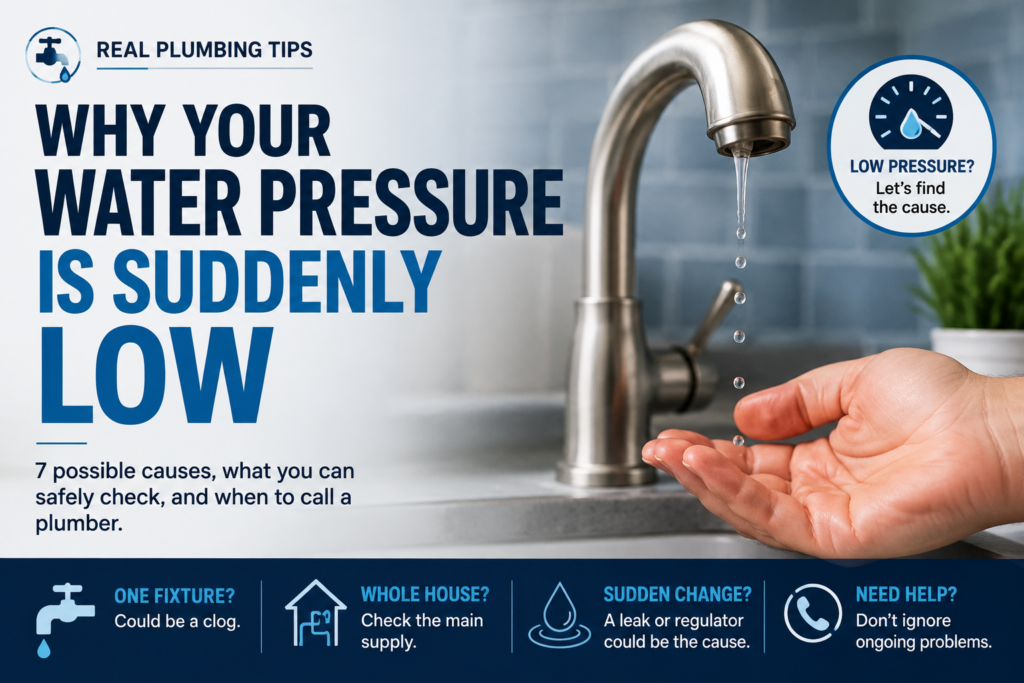
When you turn on a faucet or step into the shower, you probably expect a strong, steady stream of water. When your water pressure is suddenly low, the change can be annoying—but it can also be an early warning that something in your plumbing system needs attention.
Before assuming you have a major plumbing problem, determine whether the low pressure affects one fixture, only the hot water, or the entire house. That simple test can help narrow down the cause.
Here are seven possibilities.
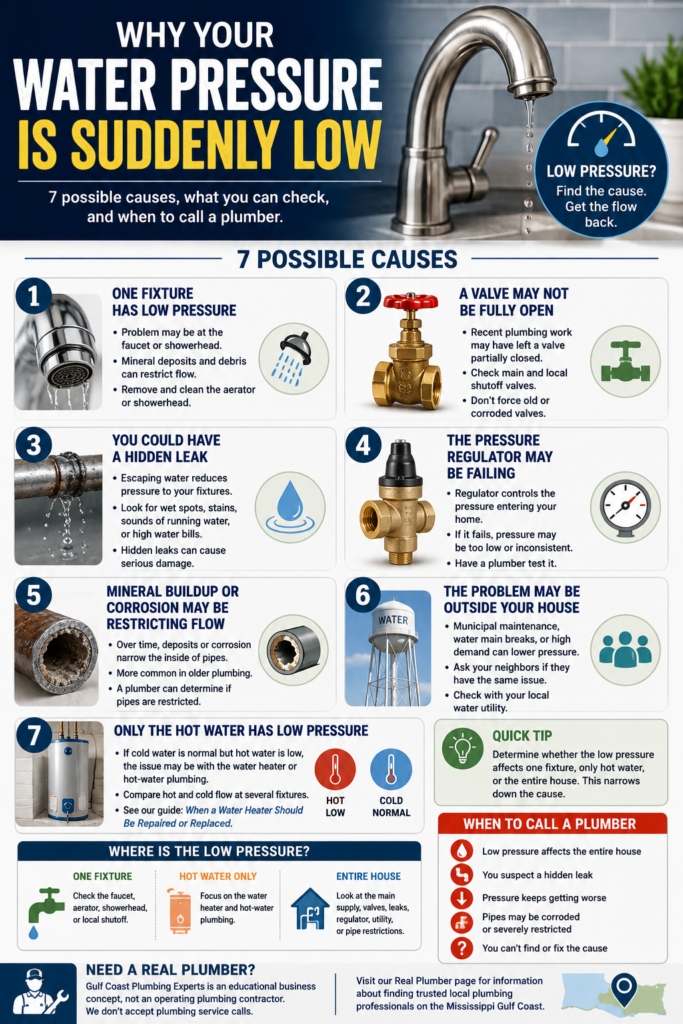
1. The Problem Is Limited to One Faucet or Shower
Start with the simplest possibility.
Turn on several faucets around the house. Check both hot and cold water.
If the pressure is low at only one faucet or showerhead, the problem may be at that fixture rather than throughout your plumbing system.
Mineral deposits and debris can restrict faucet aerators and showerheads over time.
If you’re comfortable doing so, remove and inspect the aerator or showerhead. Cleaning accumulated mineral deposits may restore normal flow.
If every fixture has low pressure, keep looking.
2. A Water Valve May Not Be Fully Open
Your home’s plumbing system has valves controlling water flow.
If someone recently performed plumbing work, replaced a water heater, repaired a leak, or worked on the municipal water system, a valve may have been partially closed and not completely reopened.
Check accessible valves that you know how to operate.
Don’t force a valve that is corroded, damaged, or difficult to move. An old valve can begin leaking or break when disturbed.
3. You Could Have a Hidden Water Leak
A sudden pressure drop throughout the house deserves more attention because escaping water can reduce the amount reaching your fixtures.
Look for other clues:
- Unexplained wet areas
- Water stains on walls or ceilings
- Damp cabinets
- Sounds of running water when fixtures are off
- An unusually high water bill
- Water collecting near the foundation
A hidden leak can cause significant property damage before it becomes obvious.
If you suspect one, don’t ignore it simply because you can’t see water.
4. Your Pressure Regulator Could Be Failing
Some homes have a pressure-reducing valve, commonly called a pressure regulator, that controls the pressure entering the house.
If the regulator begins failing, you may experience low pressure, excessive pressure, or changes in pressure.
This generally isn’t something to diagnose by randomly adjusting the regulator.
A plumber can test the home’s water pressure and determine whether the regulator is actually responsible.
5. Mineral Buildup or Pipe Corrosion May Be Restricting Flow
Plumbing systems can change internally as they age.
Mineral deposits may accumulate, and some older pipe materials can corrode from the inside. As the available opening becomes smaller, water flow can decline.
This tends to be more likely when pressure has gradually deteriorated rather than dropping overnight.
The solution may involve more than simply increasing pressure. A plumber may need to determine whether sections of the plumbing system have become restricted.
6. The Problem May Be Outside Your House
Not every water-pressure problem originates inside your plumbing.
Municipal maintenance, a water-main problem, temporary system demand, or another utility issue can sometimes reduce pressure in an area.
Ask a neighbor whether their water pressure has also changed.
If several nearby homes suddenly have the same problem, check with your local water utility before paying someone to troubleshoot plumbing inside your house.
7. Check Whether Only the Hot Water Has Low Pressure
This is an important clue.
If cold-water pressure is normal throughout the house but hot-water pressure is low, the problem may involve the water heater or the hot-water side of the plumbing system.
Compare hot and cold flow at several fixtures.
If the problem consistently appears only when using hot water, the investigation should focus there rather than on the home’s entire water supply.
If your water heater is also getting older or showing other problems, see our guide When a Water Heater Should Be Repaired or Replaced.
One Fixture, Hot Water, or the Whole House?
When your water pressure is suddenly low, these three questions can save considerable troubleshooting time:
One fixture?
Start with the faucet, aerator, showerhead, or local shutoff.
Hot water only?
Investigate the water heater and hot-water plumbing.
Entire house?
Consider the main supply, valves, leaks, pressure regulator, utility system, or restrictions in the plumbing.
That doesn’t diagnose every problem, but it gives you a much better starting point.
When Low Water Pressure Needs Professional Attention
Consider calling a plumber when the pressure drop affects the entire house, you suspect a hidden leak, the problem continues getting worse, pipes may be corroded, or you cannot identify the cause.
A sudden unexplained change deserves particular attention.
Low water pressure is sometimes just an inconvenience. A hidden leak isn’t.
Need a Real Plumber?
Gulf Coast Plumbing Experts is an educational business concept, not an operating plumbing contractor. We don’t accept plumbing service calls.
If you’re on the Mississippi Gulf Coast and need professional help diagnosing low water pressure, visit our Real Plumberpage for information about finding actual local plumbing professionals.
Don’t Just Learn to Live With Low Pressure
It’s easy to gradually adjust to a weak shower or a faucet that takes longer to fill the sink.
But water pressure is information.
If your water pressure is suddenly low, determine whether the problem affects one fixture, only the hot water, or the entire house. That simple investigation may reveal an easy fix—or give you an early warning about a plumbing problem worth addressing before it becomes more expensive.