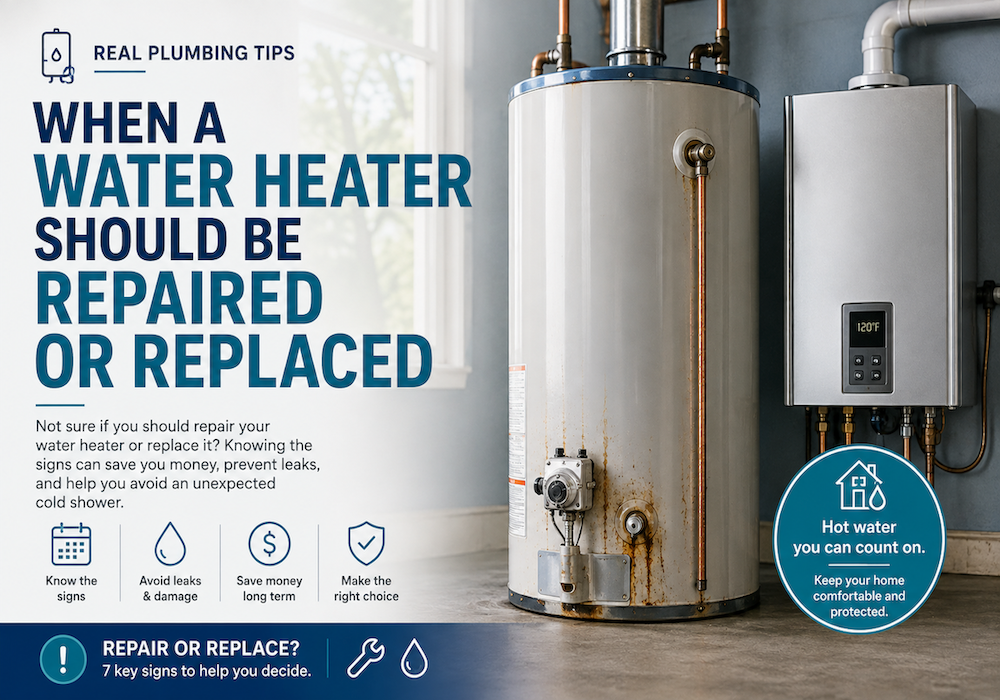
Few homeowners think much about their water heater until the shower suddenly turns cold—or they discover water on the floor around the tank.
Deciding whether a water heater should be repaired or replaced isn’t always obvious. A relatively new unit with a failed component may be worth repairing, while spending hundreds of dollars on an aging, corroded tank may only postpone the inevitable.
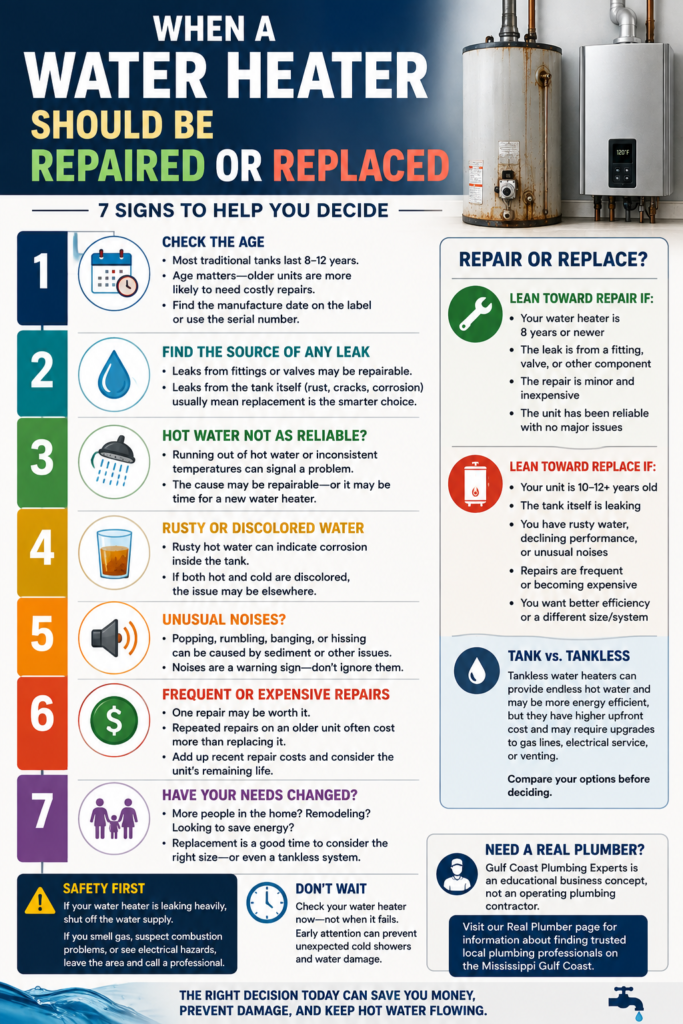
These seven signs can help you decide what to do next.
1. Start With the Age of the Water Heater
Age doesn’t automatically mean a water heater needs replacement, but it should be part of the decision.
Check the manufacturer’s label for the model and serial number. If you aren’t sure how old the unit is, the manufacturer may provide an online serial-number lookup or customer service number.
An older water heater that needs its first inexpensive repair may still have useful life remaining. An older unit requiring repeated repairs deserves a closer look.
2. Determine Exactly Where the Water Is Leaking
A leak doesn’t always mean you need a new water heater.
Water can come from a fitting, connection, valve, drain, or another replaceable component. Those problems may be repairable.
A leak caused by deterioration or corrosion of the tank itself is much more serious.
If water is collecting around your water heater, don’t simply assume where it’s coming from. Have the actual source identified.
3. Pay Attention When Hot Water Becomes Unreliable
Maybe the water isn’t getting as hot as it once did.
Perhaps showers turn cold sooner, or the household suddenly doesn’t seem to have enough hot water.
The cause could be a repairable component, sediment buildup, a thermostat problem, heating-element trouble, or another issue.
But declining performance from an aging water heater can also be a reason to compare the cost of another repair with replacement.
4. Don’t Ignore Rusty or Discolored Hot Water
Discolored water deserves investigation.
The problem isn’t necessarily the water heater. Pipes, the public water supply, a private well, or other parts of the plumbing system can sometimes affect water color.
One useful clue is whether the discoloration appears in both hot and cold water or primarily in the hot water.
If corrosion inside an aging water heater is responsible, replacement may be approaching.
5. Listen for New or Unusual Noises
Water heaters aren’t always silent, but new popping, rumbling, banging, or other unusual sounds shouldn’t automatically be dismissed.
Sediment can accumulate at the bottom of a tank over time. Other mechanical or operating issues can also produce unusual noises.
Noise alone doesn’t tell you to replace the unit. It tells you that the water heater deserves attention.
6. Consider How Often You’re Paying for Repairs
One repair can make perfect financial sense.
Then another happens.
And another.
At some point, repeatedly repairing an older water heater can become more expensive than putting that money toward a replacement.
Don’t evaluate only today’s repair bill. Ask:
How much have I spent on this water heater recently, and how confident am I that this repair will solve the problem for a reasonable period of time?
That is a much better financial question.
7. Consider Whether Your Household Needs Have Changed
Replacement can also be an opportunity.
Perhaps your household has grown and regularly runs out of hot water. Maybe fewer people live in the house now. You may be remodeling, improving energy efficiency, or reconsidering where the water heater is located.
This is also when homeowners frequently ask about tankless water heaters.
Tankless systems can be an excellent choice in the right situation, but they aren’t automatically the best choice for every house. Installation requirements, fuel or electrical capacity, household demand, initial cost, and expected usage all matter.
If replacement is necessary anyway, compare your options rather than automatically buying an identical unit.
Repair or Replace? Look at the Whole Picture
There isn’t one rule that applies to every water heater.
A younger unit with a failed replaceable component may be a strong candidate for repair.
An aging water heater with tank corrosion, recurring problems, declining performance, and mounting repair expenses may make replacement the more practical choice.
The important thing is to diagnose the actual problem before spending money.
A Leaking Water Heater Can Become an Emergency
If a water heater is actively releasing significant amounts of water, don’t wait for the repair-versus-replace debate.
Protect the house first.
If you know how to safely shut off the water supply to the unit, do so. Be especially cautious around electrical connections, gas equipment, and standing water.
If you smell gas, suspect combustion or venting problems, or encounter an electrical hazard, don’t attempt a DIY diagnosis.
Get qualified professional help.
Need a Real Plumber?
Gulf Coast Plumbing Experts is an educational business concept, not an operating plumbing contractor. We don’t accept plumbing service calls.
If you live on the Mississippi Gulf Coast and need someone to inspect, repair, or replace a water heater, visit our Real Plumber page for information about finding actual local plumbing professionals.
Don’t Wait Until You’re Standing in Cold Water
The best time to think about replacing a water heater isn’t necessarily the morning it stops working.
If your unit is getting older, find its age now. Look periodically for moisture, corrosion, or other changes and pay attention to declining performance.
When a problem eventually appears, you’ll be in a much better position to decide whether your water heater should be repaired or replaced—instead of making an expensive decision while waiting for the next hot shower.