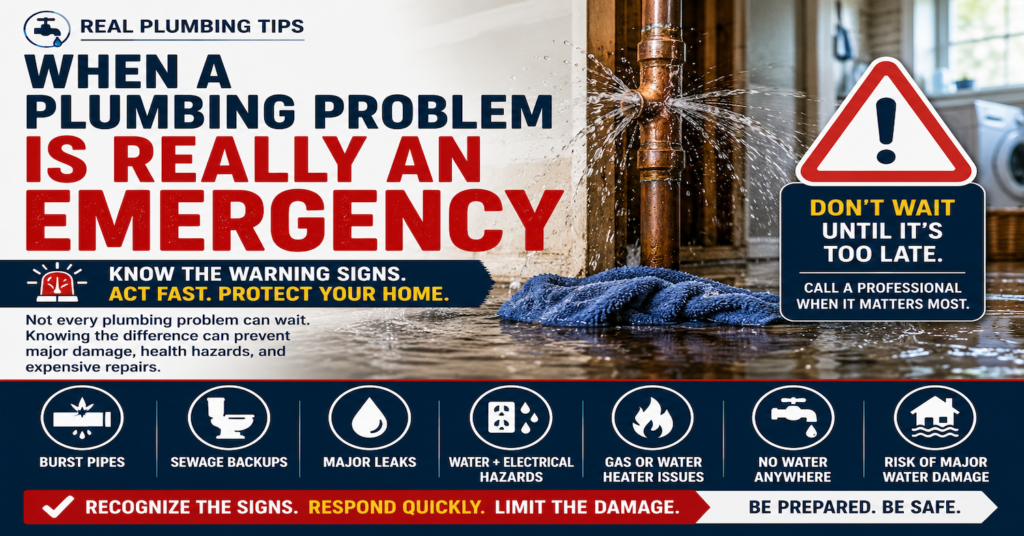
Not every dripping faucet or slow drain requires an emergency plumber. But some plumbing problems can cause serious property damage or create safety and health hazards if you wait.
Knowing when a plumbing problem is really an emergency can help you respond quickly without treating every minor plumbing issue like a crisis.
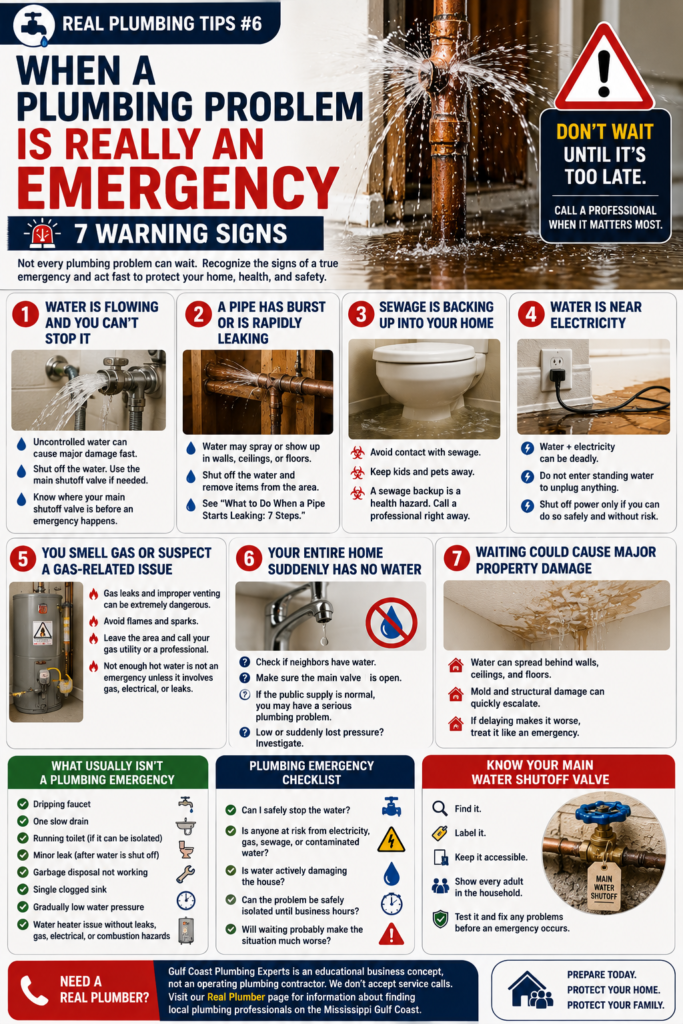
Here are seven warning signs that deserve immediate attention.
1. Water Is Flowing and You Can’t Stop It
Uncontrolled water is one of the clearest signs of a plumbing emergency.
A broken supply line, failed fixture, overflowing appliance connection, or other plumbing failure can release a large amount of water surprisingly quickly.
Your first priority is stopping the water.
If the problem has an accessible local shutoff valve, use it. If you can’t isolate the leak, you may need to shut off the home’s main water supply.
This is why every homeowner should know how to find the main water shutoff valve before an emergency occurs.
Once the water is stopped, you can evaluate the damage and arrange for repairs.
2. A Pipe Has Burst or Is Rapidly Leaking
A burst pipe doesn’t necessarily look like something from a movie.
Sometimes water sprays dramatically from the pipe. Other times, the first clue is water running down a wall, appearing through a ceiling, or collecting somewhere it shouldn’t.
Treat a rapidly leaking pipe seriously.
Shut off the water if you can safely do so and move belongings away from the affected area.
See our related guide, What to Do When a Pipe Starts Leaking: 7 Immediate Steps, for more information.
3. Sewage Is Backing Up Into Your Home
A sewage backup is different from an ordinary slow drain.
If wastewater or sewage is backing up through toilets, tubs, showers, or floor drains, avoid contact with it.
Sewage can contain harmful microorganisms and other contaminants.
Keep children and pets away from the affected area and avoid attempting repairs that expose you to wastewater.
A significant sewage backup generally deserves prompt professional attention.
4. Water Is Near Electricity
Water near electrical wiring, outlets, appliances, extension cords, electrical panels, or other energized equipment can create a dangerous situation.
Do not walk into standing water to unplug something or reach an electrical panel.
If electricity can be safely shut off without entering or reaching across the wet area, that may help reduce the hazard. Otherwise, stay clear and contact qualified professionals.
Protecting the house matters.
Protecting yourself matters more.
5. You Smell Gas or Suspect a Gas-Related Water Heater Problem
Some plumbing equipment also involves natural gas or propane.
If you smell gas or suspect a fuel leak involving a water heater or other appliance, don’t treat it as an ordinary plumbing repair.
Avoid flames and anything that could create a spark. Leave the affected area and follow your gas utility’s emergency procedures.
Problems involving combustion or improper water-heater venting can also be serious.
A water heater that simply isn’t producing enough hot water may not be an emergency. A situation involving suspected gas leakage or unsafe combustion is different.
For non-emergency water-heater problems, see When a Water Heater Should Be Repaired or Replaced: 7 Signs.
6. Your Entire Home Suddenly Has No Water
One faucet without water is usually a localized problem.
An entire house suddenly losing water deserves investigation.
Before assuming your plumbing has failed, determine whether neighbors have water. Municipal maintenance or a water-main problem could be responsible.
If the public supply is operating normally, make sure the home’s main valve hasn’t accidentally been closed.
A sudden loss of water accompanied by unusual sounds, wet areas, or unexplained pressure changes could indicate a plumbing problem that requires professional attention.
Similarly, if your water hasn’t completely stopped but the water pressure is suddenly low, investigate rather than simply accepting the change.
7. Waiting Could Cause Major Property Damage
Sometimes the best way to determine whether a plumbing problem is really an emergency is to ask one question:
What is likely to happen if I wait until tomorrow?
A small drip caught in a bucket after the water has been safely isolated may be able to wait.
Water actively entering walls, ceilings, flooring, cabinets, or other parts of the house may not.
Water damage can spread well beyond the original plumbing repair.
When delaying the repair is likely to substantially increase the damage, treating the situation as an emergency can make financial sense.
What Usually Isn’t a Plumbing Emergency?
Some problems need to be repaired but don’t necessarily require an emergency service call.
Examples may include:
- A dripping faucet
- One slow drain
- A running toilet that can be isolated
- A minor leak after the water has been successfully shut off
- A garbage disposal that stops working
- A single clogged sink
- Gradually declining water pressure
- A water heater problem that doesn’t involve leaking, gas, electrical, or combustion hazards
The circumstances matter.
For example, one slow kitchen drain may not be an emergency. Sewage backing up through multiple drains is a completely different situation.
Our guide What Should Never Go Down a Kitchen Drain explains several simple ways to reduce the risk of kitchen drain clogs.
A Simple Plumbing Emergency Checklist
When something goes wrong, don’t panic and start taking the plumbing apart.
Ask:
Can I safely stop the water?
Is anyone at risk from electricity, gas, sewage, or contaminated water?
Is water actively damaging the house?
Can the problem be safely isolated until normal business hours?
Will waiting probably make the situation substantially worse?
The answers can help distinguish an inconvenient plumbing problem from a genuine emergency.
Know Your Main Water Shutoff Before You Need It
One of the best ways to prepare for a plumbing emergency costs almost nothing.
Find your main water shutoff valve.
Label it.
Make sure it remains accessible.
Show every adult in the household where it is.
If the valve is badly corroded, stuck, leaking, or doesn’t completely stop the water, have it inspected before an emergency occurs.
When a pipe breaks, a few minutes can matter.
Need a Real Plumber?
Gulf Coast Plumbing Experts is an educational business concept, not an operating plumbing contractor. We don’t accept emergency or routine plumbing service calls.
If you’re on the Mississippi Gulf Coast and have a plumbing problem requiring professional attention, visit our Real Plumber page for information about finding actual local plumbing professionals.
For an immediate threat involving fire, gas, electricity, or another life-safety hazard, follow the appropriate local emergency or utility procedures rather than relying on a plumbing article.
Know the Difference and Act Quickly
A plumbing emergency isn’t defined simply by how inconvenient the problem feels.
Think about water flow, safety, contamination, and potential property damage.
A dripping faucet can probably wait. Uncontrolled water, sewage entering the home, water around electrical equipment, a suspected gas problem, or rapidly increasing property damage usually shouldn’t.
Knowing when a plumbing problem is really an emergency helps you do two things at once: avoid unnecessary emergency calls for minor problems and respond quickly when waiting could make a serious situation much worse.