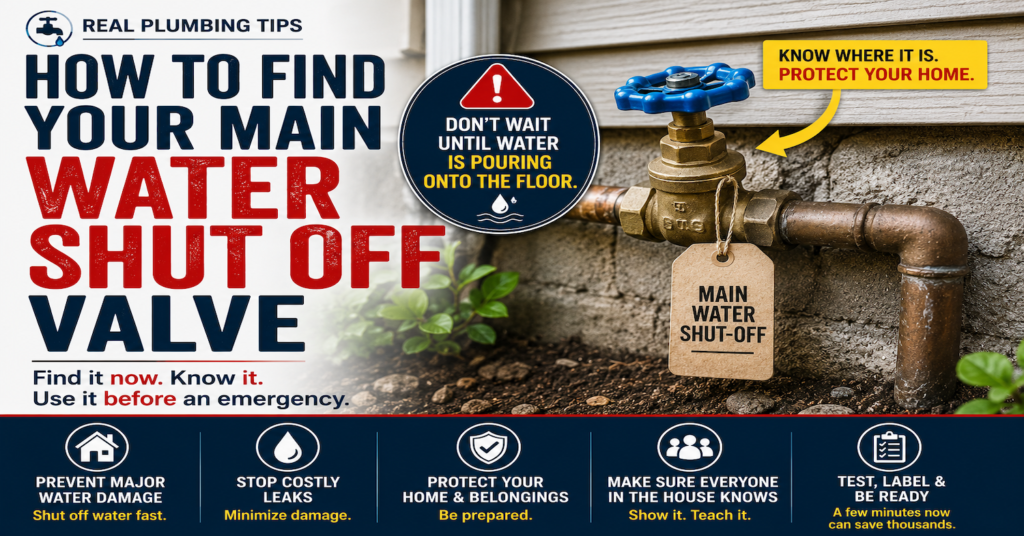
A burst pipe, failed supply line, or major plumbing leak can release a surprising amount of water in a short time. In that situation, knowing how to find your main water shutoff valve can make the difference between a manageable cleanup and significant water damage.
The worst time to start searching for the valve is when water is already pouring onto the floor.
Find it now. Make sure it works. Show everyone in your household where it is.
Why Your Main Water Shutoff Valve Matters
Your main water shutoff valve controls the water supply entering your home.
Closing it can stop or substantially reduce water flowing from many plumbing failures inside the house.
You may need it if:
- A pipe bursts or begins leaking heavily.
- A washing-machine or appliance supply line fails.
- A plumbing fixture breaks.
- A toilet supply line won’t stop flowing.
- Plumbing work requires the house water to be turned off.
Not every leak requires shutting off the entire house. Many fixtures and appliances have individual shutoff valves.
But when you can’t quickly isolate a major leak, the main shutoff becomes extremely important.
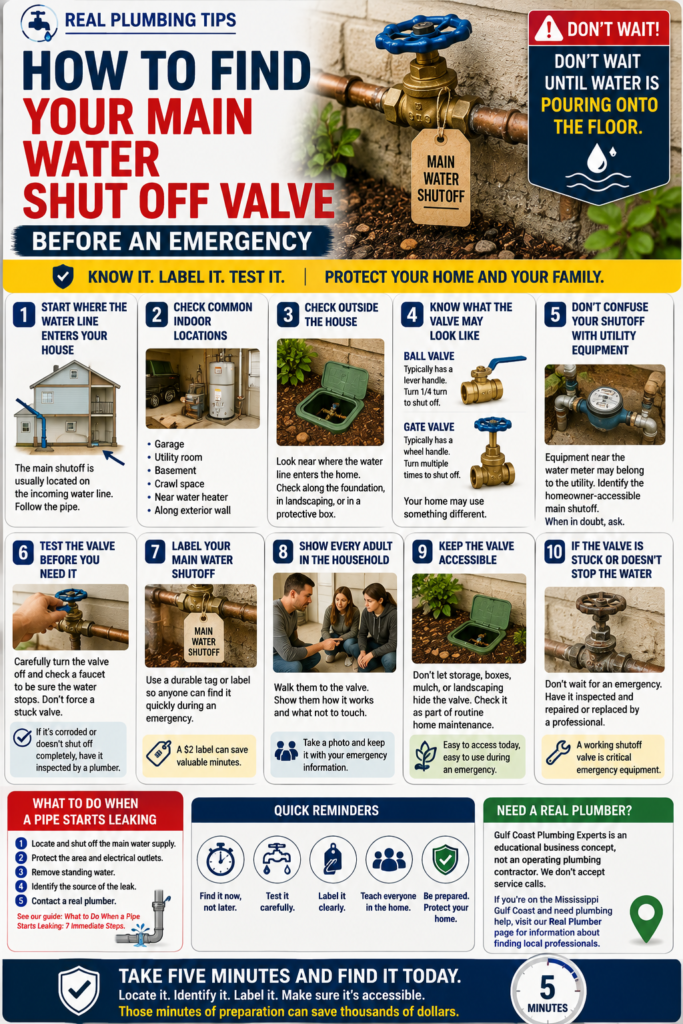
1. Start Where the Water Line Enters Your House
When learning how to find your main water shutoff valve, think about where the public or private water supply enters the building.
The valve is often located somewhere along that incoming water line.
Depending on the home’s design and location, that could put the valve inside or outside.
Follow visible plumbing where possible rather than randomly turning valves.
2. Check Common Indoor Locations
In some homes, the main shutoff is inside.
Look in areas such as:
- A garage
- Utility room
- Basement
- Mechanical room
- Crawl-space access area
- Near the water heater
- Along an exterior-facing wall
- Near where the main water line penetrates the foundation
The exact location varies considerably by house.
If you find several valves and aren’t certain which controls the main supply, don’t guess.
3. Check Outside the House
In warmer climates, including many homes along the Gulf Coast, plumbing configurations may place an accessible shutoff outside.
Look around the perimeter of the house, particularly near the point where the water service line appears to enter the building.
The valve might be close to an exterior wall or contained in a protective box.
Landscaping, mulch, leaves, and years of changes around a house can sometimes make valves surprisingly difficult to spot.
4. Know What the Valve May Look Like
Two common valve designs are ball valves and gate valves.
A ball valve typically has a lever-style handle. In many installations, turning the handle a quarter-turn changes the valve from open to closed.
A gate valve commonly has a round wheel-style handle that is turned multiple times.
Your home may use something different, particularly if the plumbing is older.
Don’t rely on appearance alone if you’re uncertain that you’ve located the correct valve.
5. Don’t Confuse Your Shutoff With Utility Equipment
You may also find valves and equipment near the water meter.
Some of that equipment belongs to or is controlled by the local water utility. Rules regarding homeowner access can vary.
Don’t operate utility equipment simply because it appears capable of shutting off the water.
Identify the homeowner-accessible main shutoff for your property. If you can’t locate one, ask a plumber or your water provider what applies to your home.
6. Test the Valve Before You Need It
Finding the valve is only half the job.
You also want reasonable confidence that it will work.
Older valves can become stiff, corroded, partially seized, or unable to completely stop water flow.
Don’t aggressively force a badly corroded valve. Breaking a main shutoff can turn your preparedness exercise into the plumbing emergency you were trying to prevent.
If the valve appears to be in good condition and you’re comfortable operating it, carefully test it and verify that water flow stops at a faucet.
If you’re unsure, have a plumber inspect it.
7. Label Your Main Water Shutoff Valve
Once you know you’ve found the correct valve, make it obvious.
Attach a durable label:
MAIN WATER SHUTOFF
During an emergency, you may not be the person who needs to use it.
A spouse, adult child, house sitter, neighbor, or someone else helping with the property should be able to identify it quickly.
A $2 label could save valuable minutes.
8. Show Every Adult in the Household
Don’t keep the location in your head.
Walk other adults in the household to the valve and physically show them:
- Where it is
- How to reach it
- Which valve is the correct one
- How it operates
- What not to touch
Consider taking a photo and keeping it with your household emergency information.
Knowing that someone once showed you the valve isn’t nearly as useful as being able to find it immediately.
9. Keep the Valve Accessible
Finding the valve today doesn’t help much if it disappears behind storage boxes next year.
Keep the area reasonably accessible.
If the valve is outdoors, make sure landscaping, soil, mulch, or other materials don’t gradually hide it.
Check its location occasionally as part of normal home maintenance.
10. What If the Valve Is Stuck or Doesn’t Stop the Water?
Don’t wait for an emergency to solve that problem.
If the valve is heavily corroded, difficult to operate, leaking, damaged, or unable to completely shut off the water, consider having it professionally inspected and replaced.
A main shutoff valve is emergency equipment for your house.
It needs to work when you need it.
What to Do When a Pipe Starts Leaking
Knowing the location of your main shutoff is especially valuable during a pipe leak.
If you discover a significant leak and can’t isolate it with a local valve, shutting off the main water supply may help limit additional damage.
After stopping the water, the next priorities include protecting the area, safely addressing electrical hazards, removing standing water, and determining where the leak originated.
See our related guide: What to Do When a Pipe Starts Leaking: 7 Immediate Steps.
Need a Real Plumber?
Gulf Coast Plumbing Experts is an educational business concept, not an operating plumbing contractor. We don’t accept plumbing service calls.
If you’re on the Mississippi Gulf Coast and can’t locate your main shutoff, the valve doesn’t work, or you need plumbing repairs, visit our Real Plumber page for information about finding actual local plumbing professionals.
Take Five Minutes and Find It Today
This is one home-maintenance task that shouldn’t remain on a future to-do list.
Learn how to find your main water shutoff valve before you need it.
Locate it. Identify it. Label it. Make sure it’s accessible. Show everyone in the household where it is.
Those few minutes of preparation could save thousands of dollars when a plumbing emergency gives you only minutes to act.